sewage treatment


From the concept through design, sizing and installation, to maintenance, our engineering department offers you a complete solution for waste water treatment. Made by REDI, the specialized Italian company in the field of drainage system, a “turnkey” solution, is provided to take care of the project, materials, assembly and testing.
Grown with this experience, REDI has developed two types of highly efficient installations, intended for effluents treatment based on the concept of activated sludge system.
Standard modules of rotomoulded polyethylene for single habitats and small residential complexes (up to 300 EH).
Tailor made installations, intended for wastewater treatment from medium size agglomerations (from 300 to 3000 EH).


Our systems are installed in several types of buildings and applications as houses, residential buildings, hotels, resorts, campsites, marina, restaurants, fast-food, wineries, dairies, food industries, car wash, car demolishers, workshops, airports, ports, logistics areas, petrol stations, power plants, refineries, agri-food industries and others.
The systems offered are:
The systems offered are:
- Wastewater: Pretreatment plants.
- Wastewater: Secondary treatment .
- Activated sludge system.
- Septic Tanks.
- Greywater recovery system.
- Rainwater Harvesting.
- Grease separators.
- Oil Separator.
- Lift Stations.



REDI Septic tanks
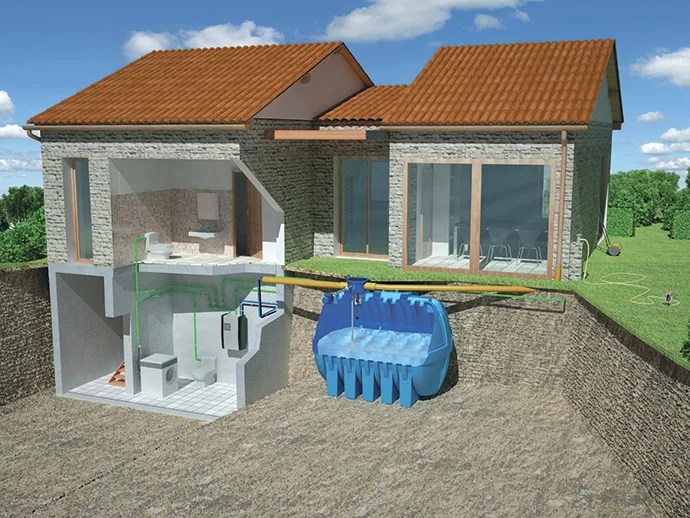
Septic tanks are used as a pre-treatment of mixed wastewater coming from civil buildings (where there is no separation between grey water originating from kitchens, washing machines, washbasins, showers, etc., and black water originating from W.C.), before being discharged into the public sewage system or upstream of an appropriate purification plant (activated sludge system, sub-irrigation, trickling filter, etc.).Septic tanks are decantation tanks suitable for sedimentation processes; in stillness condition, due to gravity, heavier solids settle to the bottom of the tank, while lighter materials (oils, greases and low density solids) float to the upper part.
It’s also possible to install two or three septic tanks in line, in order to highly improve the purifying efficiency of the system.
These products may be integrated with treatments allowing to improve the general purification efficiency, depending on incoming wastewater features and final discharge type.
The septic tanks are particularly suitable to small and medium households communities, as they allow the following advantages:
- They simplify the treatment process, by consequently reducing the number of parts, thus the necessary investment.
- They are very easy to manage and maintain.
- No electric consumption.

REDI Biological IMHOFF
Biological Imhoff tanks are commonly used as a pre-treatment of black water coming from civil buildings (originating from W.C.), before being discharged into the public sewage system or upstream of an appropriate purification plant (sub-irrigation, trickling filter, etc.).
Inside biological Imhoff tanks there are two clearly separated compartments: a superior one for sedimentation and an inferior one for decanted sludge storage and anaerobic digestion.
The sedimentable suspended solids are trapped into the sedimentation compartment and precipitate into the inferior storage and digestion compartment, passing through the opening which connects the two zones; there, all organic substances undergo an anaerobic fermentation, with the consequent stabilization of produced sludge.
These products may be integrated with treatments allowing to improve the general purification efficiency, depending on incoming wastewater features and final discharge type.
The biological Imhoff tanks are particularly suitable to small and medium households communities, as they allow the following advantages:
- They simplify the treatment process, by consequently reducing the number of parts, thus the necessary investment.
- Production of a few quantity of sludge, having a good biological stability.
- They are very easy to manage and maintain.
- No electric consumption.

REDI Grease separators
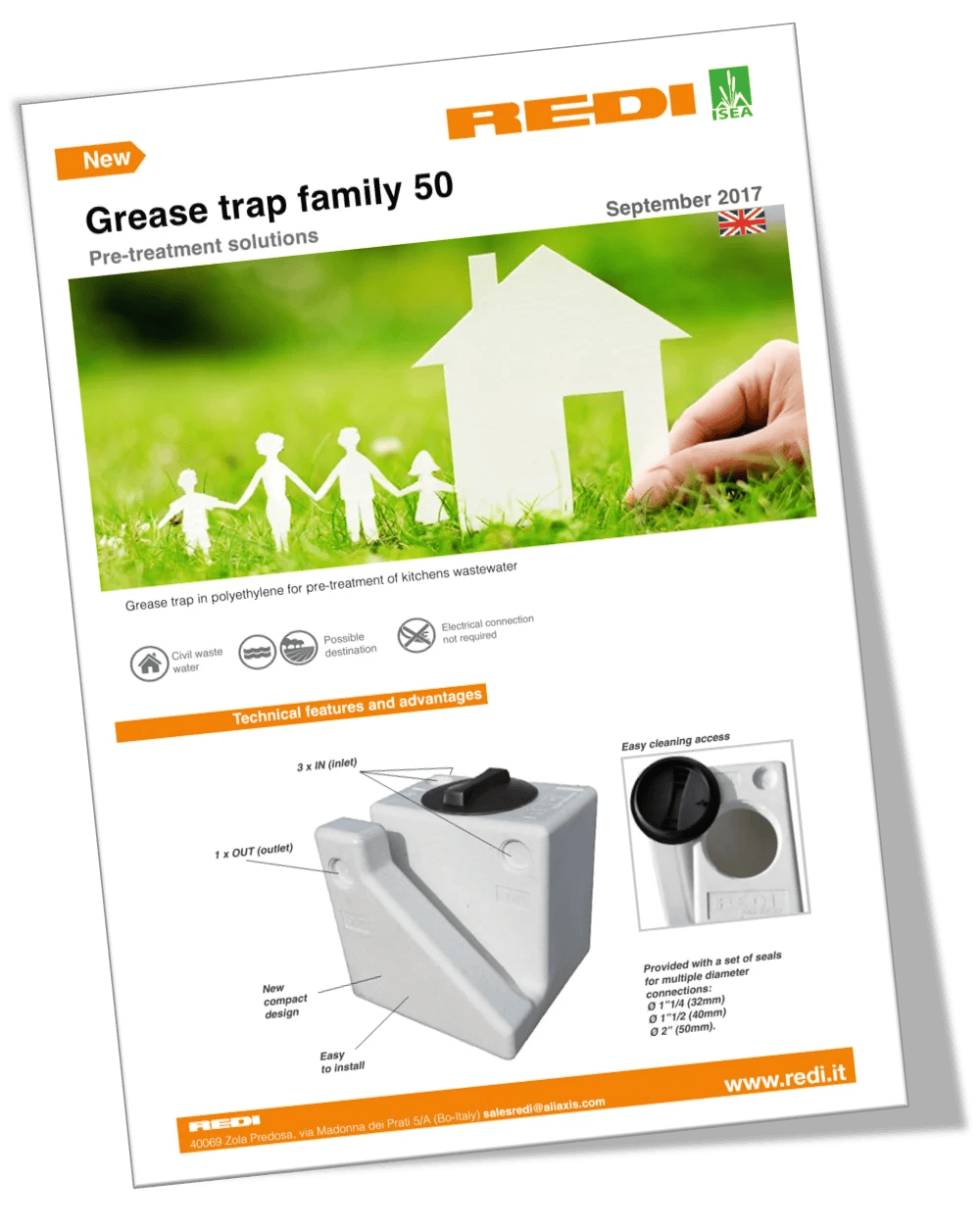
UNDER SINK PRE-TREATMENT UNIT.
Polyethylene Grease Trap, single-block, to be installed in tight spaces, e.g. under the sink, to limit the polluting load when channeled to either a public sewer or a private treatment plant.
Designed to obtain an efficient grease separation and a good hydraulic flow, it is suitable to be used when the installation of a standard grease trap underground is not possible.
The Grease Trap is equipped with a threaded cover for full inspection and easy removal of grease and other floating materials. The product is completely made of recyclable materials.

REDI Lift Stations
The pumping stations are used for lifting the wastewaters to final destinations that are located higher and at a certain distance from the discharge point.
They may also be used for controlling the incoming sewage flow towards the purification plants, by ensuring a constant flow where it is needed.
The lifting of the wastewater – which may be raw or pre-treated black water, rainwater or paved surface washing water – is performed by electro pumps that are placed (singularly or coupled) inside basins having the appropriate dimensions; they are placed inside them with mobile installation and they are equipped with all necessary fittings.
The pumping stations operation is controlled by floating level sensors and/or by electric control panels (depending on the item).
The pumping stations may be combined with the purification plants in different ways, depending on the specific project requirements.

REDI Activated sludge plants
Activated sludge (or “total oxidation”) treatment plants are used for residential wastewater which can’t be discharged into a public drainage system.
The purification process is biological and it’s based on the action of aerobic bacteria, which are fed by the organic substances contained in the incoming sewage.
Activated sludge plants are divided into an oxidation area, where required air is diffused in order to allow the bacteria survival, and a sedimentation area, where the biggest sludge aggregates are separated from outgoing out water.
These plants may be integrated with pre- and post- treatments that allow to improve the total purification efficiency, depending on wastewater features and final discharge type.
Activated sludge plants are particularly suitable to small and medium households communities, as they offer the following advantages:
- They simplify the treatment process, by consequently reducing the number of parts, thus the necessary investment
- They allow to achieve an outstanding purification level, keeping treated water features very stable
- They allow the production of a small quantity of excess sludge, which is biologically stable.
- They are very easy to manage and maintain.
- They limit the electric consumption.

REDI Sub-irrigation
The sub-irrigation and phytoremediation systems with absorbent trays are used for civil wastewater which are not discharged into a public sewerage system or into surface water streams.
Incoming wastewater are distributed inside absorbent trays, each one containing an adequate number of plants.
The purification process takes advantage of soil evaporation and transpiration, both direct and by means of the plants, and of wastewater organic elements absorption performed by the roots of the plants.
The only liquid outgoing the system is rainwater occurring during rainfalls, which is considered sufficiently diluted and so it may be conducted away through an overflow piping system or back to the inlet point through a specific recirculation pumping station, thus ensuring the complete absence of discharge.
These systems may be integrated with pre-treatments allowing to improve the general purification efficiency, depending on incoming wastewater features.
The sub-irrigation and phytoremediation systems are particularly suitable to small and medium households communities, as they allow the following advantages:They simplify the treatment process, by consequently reducing the number of parts, thus the necessary investment.
- They simplify the treatment process.
- They allow to achieve an outstanding purification level and the removal of the effluent discharge problem.
- They are very easy to manage and maintain.
- No electric consumption.
- Possibility of system extension in the future with small costs charge and very simple operations


REDI Trickling filters plants
Trickling filters plants are used for residential wastewaters that can’t be discharged into the public sewage system.
The treatment process is biologic and it is based on the purifying action of the bacteria flora, which grows on appropriate filling materials with high specific surface area, that fulfill the tank.
The microorganisms – which are fed by the organic substances contained in the incoming sewage – may be of anaerobic kind (i.e. they do not need free oxygen) or aerobic one (which means they need the presence of free oxygen); as a consequence there are two trickling filters treatment plants: anaerobic or aerobic.
These plants may be integrated with pre-treatments that allow to improve the total purifying efficiency, depending on wastewater features and final discharge type.
The trickling filters plants are particularly suitable to small and medium households communities, as they offer the following advantages:
- They simplify the treatment process, by consequently reducing the number of parts, thus the necessary investment.
- They allow to achieve an outstanding purification level, keeping treated water features very stable.
- They allow the production of a small quantity of excess sludge, which is biologically stable.
- They are very easy to manage and maintain.
- No electric consumption.
REDI Oil traps and separators
Oil traps are used for treating wastewaters containing oils that originate from residential, industrial or crafts areas, such as garages, squares, parking lots, mechanical workshops, vehicles washing plants, etc., before being discharged into the public sewage or before being treated in an appropriate purifying plant (pressurized filtration, chemical-physical treatment, etc.).
Sand traps are used for separating sands and inert particles present in wastewater.
Oils separation is a physical removal process of all substances having a specific weight inferior to water. Sand and inert particles separation is also a physical process, but it removes all the substances having a specific weight superior to water.
Oil traps are decantation tanks equipped with an internal section, where oils float to surface by means of physical liquid/liquid separation mechanisms. Separated substances are trapped into the internal section, while purified waters flows to the main compartment through a specific passage at the bottom of it, and then to the exit.
Sand separators are decantation tanks in which sands and inert particles settle to the bottom.
These items may be integrated with pre- and post- treatments that allow to improve the total purification efficiency, depending on incoming wastewater features and final discharge type.
Oil traps and separators are particularly suitable to small and medium households communities, as they offer the following advantages:
- They simplify the treatment process, by consequently reducing the number of parts, thus the necessary investment.
- They are very easy to manage and maintain.
- No electric consumption.

